Quick answer
TTS benchmark notes for ViiTorVoice
TTS benchmark numbers are useful signals, but they only become product decisions when they match the language, audio quality, and workflow you actually ship.
TTS benchmark Practical guide Updated 2026
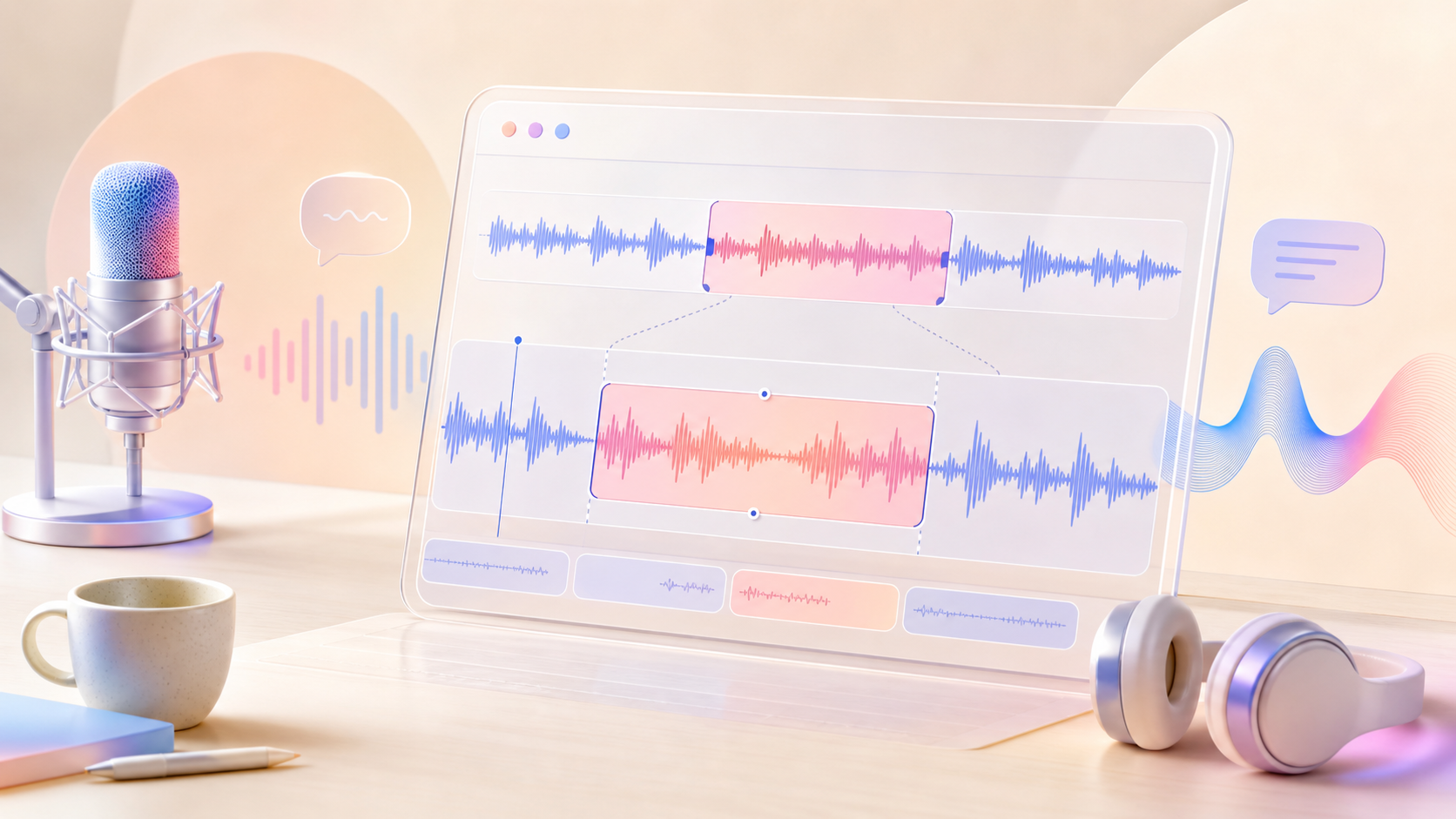
What WER tells you
Word error rate helps measure whether generated speech preserves the intended words. Lower WER can mean fewer transcript mismatches and less review time.
- Check separate results for each language you need.
- Review names and domain-specific terms manually.
- Treat very short samples and long-form narration separately.
Human review beyond WER
A voice can say the right words and still fail the job. Editors also need tone, breath, background continuity, timing, speaker similarity, and believable emphasis.
- Listen around the edited span, not only inside it.
- Compare emotional drift across the full sentence.
- Measure revision time, not only model output time.
Responsible TTS evaluation
Responsible TTS evaluation looks beyond a leaderboard number. A production benchmark should cover fidelity, comparability, standardization, privacy, misuse risk, and the limits of each test set.
- State the sample set, languages, and reviewer process.
- Separate objective metrics from subjective listening scores.
- Include consent, forgery, and disclosure risks in final decisions.
Latency and throughput
Latency claims are most useful when measured in the workflow you actually ship. Track first audio response, full output time, queue delay, retry rate, and the number of accepted edits per hour.
- Measure hosted demo latency and local runtime latency separately.
- Use the same hardware and network conditions across tests.
- Report accepted output time, not only generated output time.
Speaker similarity score
Speaker similarity is a separate judgment from transcript accuracy. Review timbre, pitch behavior, cadence, emphasis, and whether the voice drifts across longer content.
- Use blind review when possible.
- Compare prompt audio and generated audio at similar loudness.
- Score short edits and long generated lines separately.
Edit continuity score
For ViiTorVoice, local edit continuity deserves its own benchmark line. A replacement can be intelligible and speaker-matched while still sounding pasted into the original take.
- Score the two boundaries around each replacement.
- Listen for room tone, breath, and rhythm changes.
- Compare local editing against full-line regeneration.
A practical scorecard
For production, combine objective and human review. That gives teams a better answer than a single leaderboard score.
- Transcript match: pass, minor issue, or fail.
- Boundary continuity: pass, minor issue, or fail.
- Approval speed: minutes from edit request to accepted export.
Benchmark sample design
A serious TTS benchmark needs samples that represent the work. Include names, dates, brands, technical terms, emotional lines, noisy references, multilingual phrases, short clips, and long passages.
- Keep samples stable so model changes are comparable.
- Add a hard-case set for known workflow failures.
- Keep the evaluation rubric visible to every reviewer.
Decision threshold
A benchmark should end with an operational decision. Define the score needed for internal testing, limited production, external customer use, and workflows that still require human recording.
- Separate experimentation from production approval.
- Require human review for external-facing localized media.
- Re-run the benchmark after model, prompt, or hardware changes.
TTS benchmark FAQ
Is WER enough to choose a TTS model?
No. WER is valuable, but voice production also depends on delivery, emotion, latency, licensing, and how often editors need manual cleanup.
What should teams benchmark first?
Start with the phrases that usually break your workflow: names, numbers, multilingual lines, noisy references, and late-stage copy changes.
Use the demo as a benchmark sample generator Run the same phrases repeatedly, save outputs, and score transcript match, voice identity, naturalness, emotion, and edit continuity.